What a two-day hackathon says about how we work
Ire Gonzalez – 4 min read

Our researchers know exactly which parts of the product slow them down. Our engineers can build pretty much anything. In October we put them in the same room.
We don't have product managers at Conveo. Engineers decide what to build together with our Research Impact Leads, the researchers who run studies with our clients every day. Ideas come from both sides: sometimes engineers bring the prototype, sometimes researchers do, and when a researcher comes super prepared it's much quicker for us to build. For our Researcher Experience Hackathon, 14 of us flew in from NYC, SF and Antwerp to London and sat side by side for two half-days: Monday afternoon to shape and build, Tuesday morning to finish building and demo.
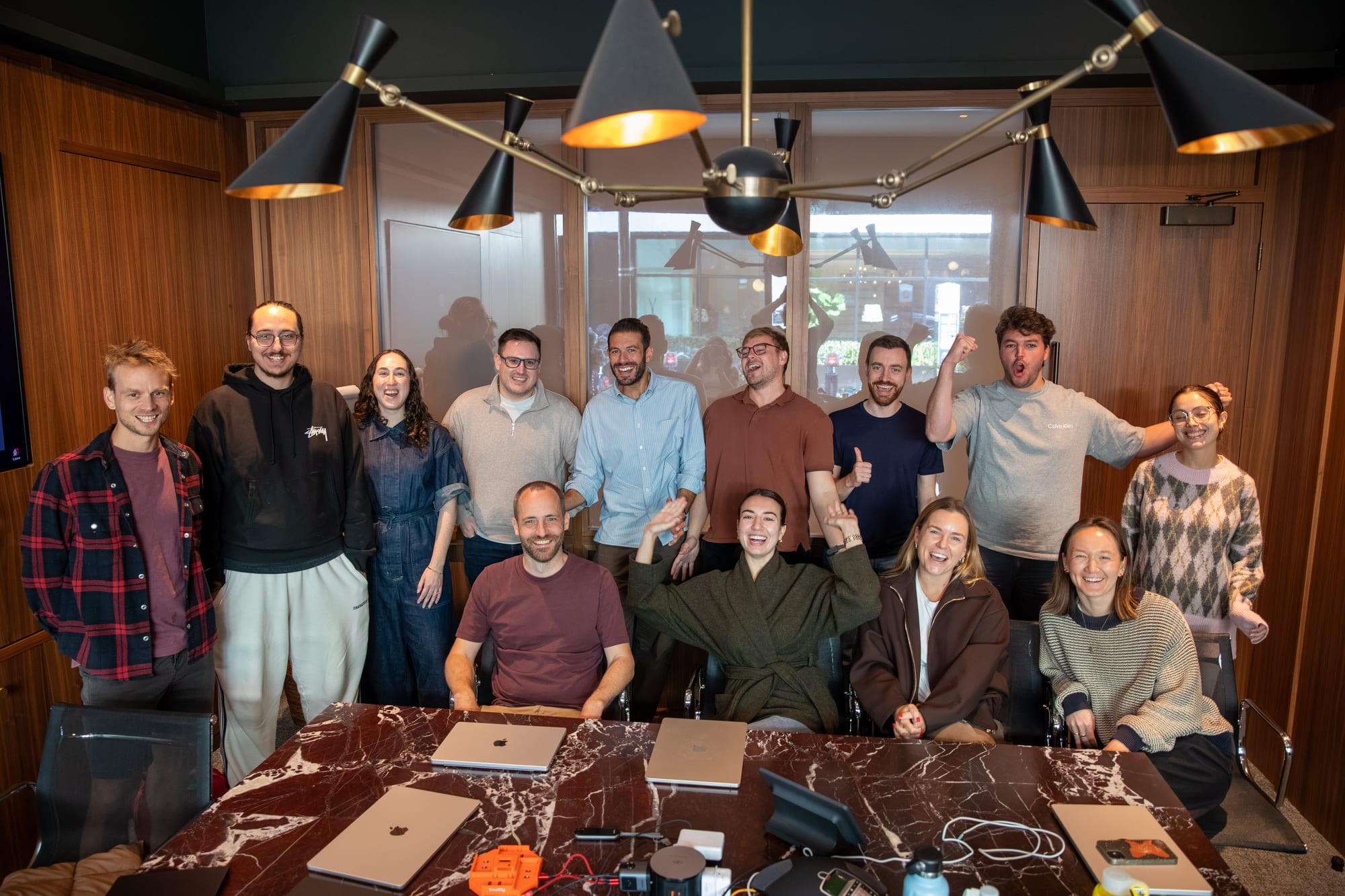
Protected time, agreed in advance
Honestly, the biggest win was the simplest one: everyone blocked the time. No client calls, no other tickets, just the things we'd agreed to work on. The researchers came with a list of topics, most of them with a prototype too, and some engineers brought their own ideas. Nobody spent Monday working out what to build.
Building in the room
We split into researcher and engineer pairs, one topic at a time each. Each pair started from whatever the researcher brought, a prototype or a pain point, and the engineers got agents building right away.
That's what made it work; with agents writing the code, engineers could stay in the conversation.
I worked on two new question types: ranking and a slider. Ranking was already mostly built, so I had agents finish it, and by Monday afternoon it was ready to test. From then on, researchers, engineers and anyone else around kept coming over to try both, and their feedback went straight back in. Meg, one of our researchers, did a full test interview and noticed you could only drag an option by the small icon on the side, not the whole box. That kind of thing normally takes a few rounds of back and forth. What we heard at 10:00 on Tuesday was in the build we demoed at 12:00.
Demo day
On Tuesday every pair showed the room what it had built. As Abby (researcher) put it, "the agents are very tired and working very hard."
Engineers gave each other feedback too. When I demoed the slider as its own question type, another engineer pointed out it looked a lot like our Carousel questions. Building it as a Carousel scale would be more consistent and quicker to ship, so that's what we did the next day.
What came out of it
We built 10 features in two days. Two and a half weeks later, six are live for every client:
- Routing preview and clearer rule editing
- Quota setup, with every quota group explained in plain English
- A question bank for screener questions
- Screener option routing and hidden variables
- A redesigned stimulus library
- Randomised stimuli that can depend on earlier draws
The research brief builder is with its first client, and heatmap questions, ranking and the slider are being tested on real studies by our own team.
Routing shows the speed best. The routing team took on the question every researcher asks about a long topic guide: who actually sees this question? Three days later the answer was on every question and section, live for every client.
Why it worked
None of this needed new tooling; it's the same setup as in our Nightwatch post. What changed was who was in the room and how much uninterrupted time we had:
- Protected time for researchers and engineers
- Topics agreed beforehand, often with a prototype
- Researchers next to engineers, so feedback took minutes
- Agents doing the implementation, so engineers could keep listening
That's how we try to work every week. For two days, we just removed everything else.
If you want to build with the people who use your features sitting next to you, we're hiring.