ASDR (AI Slop, Don't Read)
Vincent Vankrunkelsven – 4 min read

On a Wednesday morning in August, a colleague dropped a Claude artifact in #engineering. The topic: a cross-page assistant. What follows is a chain of comments that leads to the creation of a new emoji. Rather than type it all out, here's a screenshot (anonymized of course, there's a strict policy against public shaming at Conveo):
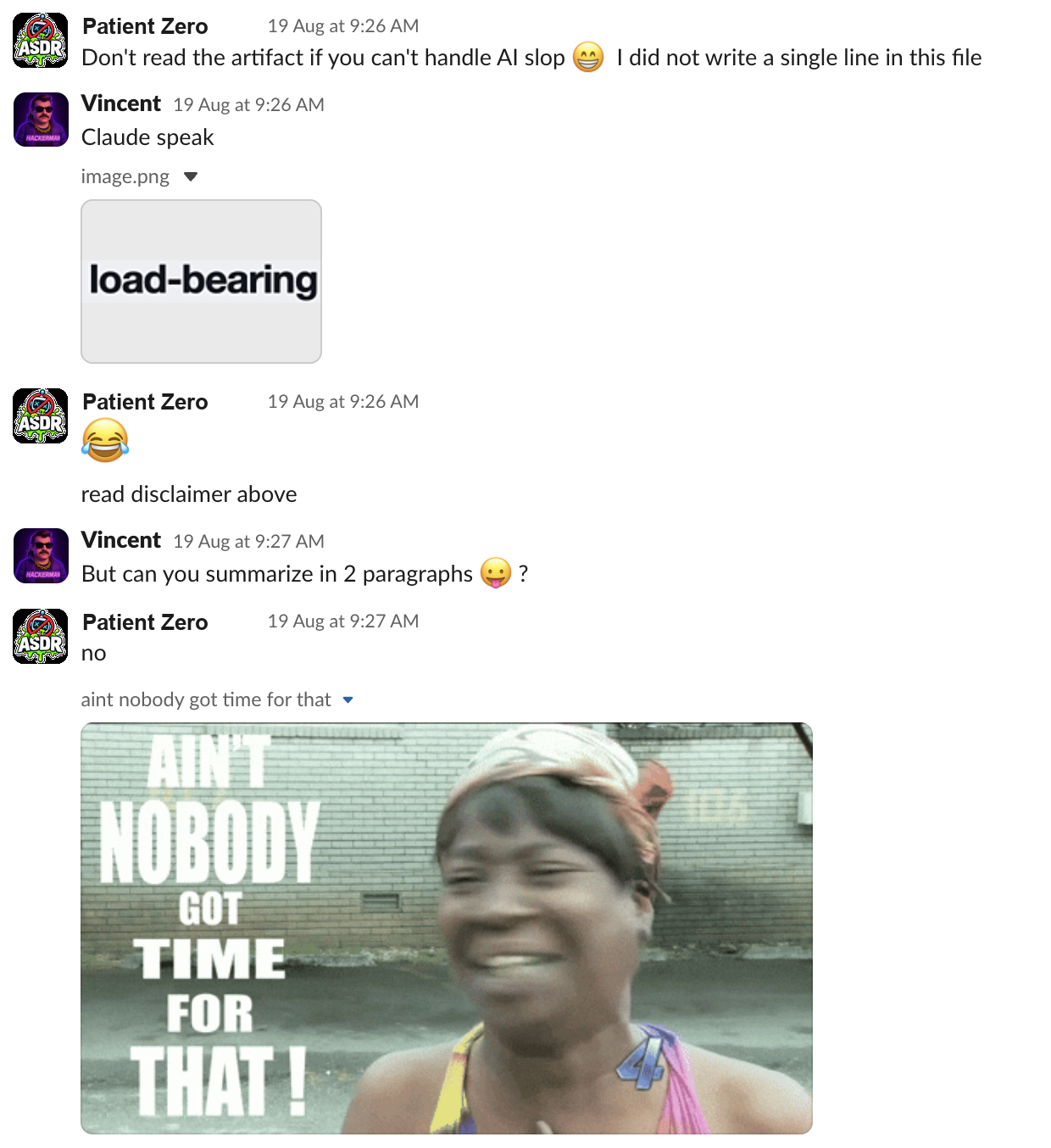
Turns out, nobody had properly read the document and a few minutes later, we concluded it was probably wrong. This triggered my reaction:
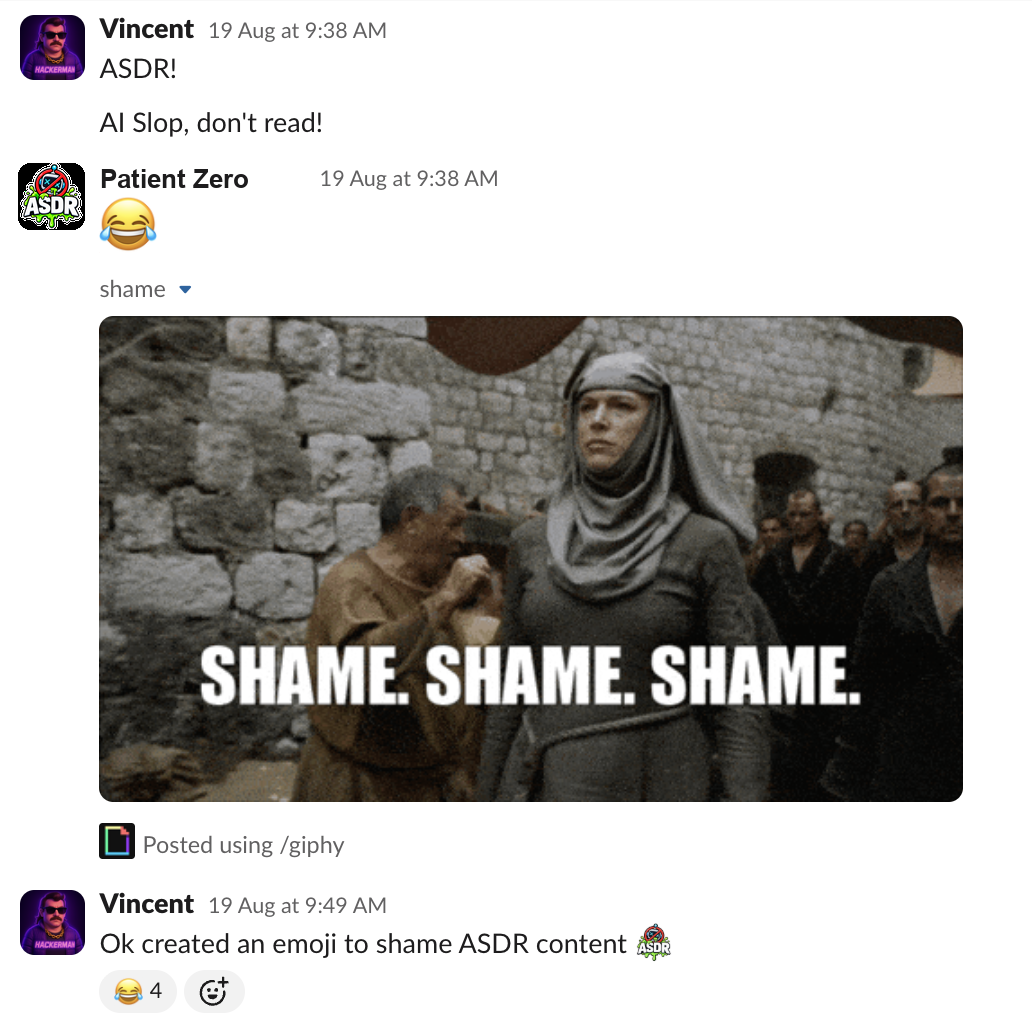
And so a new meme was born! He called it my most important contribution of the day. All in all, we're still friends.
The contract
Jokes aside, the whole interaction did set something in motion. Like every engineering team, we're going through a transformative moment at Conveo. We realized we are no longer resource constrained on building, but on deciding what to build. We're planning more, writing more, and testing more flows. Part of this means sharing detailed specs, or refinement documents. We started talking about what we expect to read in those kinds of documents. It led to a contract that we uphold to each other, and made it ok to call out people who breach it.
The contract is as follows:
- You can (and should) use AI. AI is an awesome tool to gather information, synthesize it and present it in a cohesive way.
- Read every single word of the document. Do not expect others to read the full document if you haven't.
- Remove filler text. Remove metaphoric speak. Everyone who has spent some time with Claude will recognize it. Make it yours. And this is the load-bearing point (jk).
- You should spend substantially more time creating, reading, and editing the text than others spend reading. Generating 3000 words of cohesive text takes less than a minute. Reading it takes 10 minutes. 6 people reading it takes an hour away from the team.
Don't get me wrong, we still use agents to write at Conveo. There's nothing in the contract stopping us from doing this. The nightwatch post on this blog started as an outline I wrote, then got expanded by an agent, then rewritten by me because the first version sounded like an agent.
Breaking the contract
We're still learning, and sometimes slop will just slip through. But for now, we have the :asdr: emoji in Slack. Ironically one-shotted with ChatGPT, and quite sloppy itself:
Usage:
- Someone shares a doc that reads like the model wrote it and nobody edited it.
- Someone else reacts with
:asdr:. - The author either posts the two-paragraph human summary, or admits they haven't read it yet.
No other repercussions yet when you break the AI writing contract, but the light shaming already gets us pretty far.
Writing with AI
This is how I write technical docs for now:
- I use AI to gather all relevant information I need to write the document. This means gathering context from the code, Linear, Notion, GitHub, the application database, …
- I tell it what I need to have written down, roughly (bullet points).
- I ask it to keep asking me questions until all ambiguity is resolved.
- After the first output, I check the result. I read the first few paragraphs and look at the structure, and give direction there already. Here's where I tell it to remove all metaphoric speak, weird words, and so on.
- I read the full text and make edits where needed (if you read the nightwatch post, you saw that we have tooling for commenting on plan documents).
This works for me!
That's the whole system for now: a contract, an emoji, and some light shaming. And yes, I read every single word of this article before publishing it.